Wednesday, 16 October 2013
The design.
I want to make an experience to represent the actions of putting on and tying your shoes in a comfortable way. I feel that comfort is simple but meaningful, its a feel that you don't want to over power as then i feel it loses its meaning, so I want an experence that dosent have to many gadgets.
- my first part is to enlarge the action of tying your shoes to emphasize what is being done, I still want to keep it in the feet region as I fell that a main part of the act of putting on your shoes is the bending down so there is that connection will using your whole body. really wanted this part of my experience to show a large amount of comfort, as I feel i there is more of a physical connection rather then a mental connection to tying up your shoes (and mostly touch) I wanted to have a stronger connection with the prevention of physical discomfort in this part of the experience. in making this I will use soft materials, two soft paddings sewn tougher that can be laced up, this would cover the whole leg making the experience more enlarged, to make this I will make it from two pillows and three pillowcase all sewn together, two of the cases will hold the pillows and the other will act as the tongue will large satin ribbon to tie it up. all of these soft materials will prevent an uncomfortable experience physically and also manipulate the actions on tying up your shoes. I will also line the bottom of the incasing with a soft fur fabric the will create an initial physical comfort and it also create a warm environment inside the helps to make it more comfortable
- when tying up your shoes you normally sit down, so I feel that the sitting down part of the experience is quite important, to prevent discomfort i will have the chair ergonomically comfortable with the average sitting hight for the average sized person, to prevent pain and ache. I will also add padding to the chair to had even more support. the touch, warmth and ergonomics are all used to prevent physical discomfort.
- To create physiological comfort I will look at smell, the visual look of the experience and the way I act when presenting it. in one of the reading I found it explained that smell was a good way to crate comfort as it can trigger past memories and if a comforting memory will stimulate the feeling, I wanted to use this Idea as I personally find that the smell of lavender is a comforting smell, So I will cover the object in lavender oil to crate the memory.
- another physiological comfort factor is the visual look of the object, this plays on the idea on memory and history with other objects. I feel an object looks comfortable with the shapes the form creates, soft, fluid, rounded shapes and also the colours used, my personal preference on comforting colours are warm colours such as yellow, orange and white. as I am trying to keep the model simple and not over powering so I feel I will make the whole model pure white and will use soft fluid fabrics to make it so it looks comfortable before sitting on it and using it.
- when looking at how nurses use comfort, it is in their actions, even though it is over a long period of time for them to create their time of comforting actions to their patients i want to try and use their type of personality of make the experience more mentally comfortable; friendly, gentle, kind and friendly.
- time is also a factor that I feel it a big part of comfort, I want to keep it short and simple as we take comfort for granted I feel that the user would start loosing the comfortable feeling it I keep it going for to long, so it should only last about 2 minutes.
comfortabel experience
After doing readings on both psychological and physical comfort and looking at the difference of comfort and discomfort I found that the psychological accept played a more fundamental part of creating comfort then a physical object, as it was easier to determine wether an object was my physically uncomfortable or not uncomfortable rather then determining if it was comfortable due to comfort being a subjective phenomenon (Vink, 2005) and also we take physical comfort for granted as physical comfort is stronger after discomfort (Farrell, 2009).
There are two parts I want to portray in my experience
First I want to create an environment to prevent discomfort physically, such as;
There are two parts I want to portray in my experience
First I want to create an environment to prevent discomfort physically, such as;
- Using soft fabrics and textures such as fur, or satin and having soft padding that works ergonomically. Also colours that are deemed warm like orange, white or yellow
- a warm environment with temperature and and humidity.
- Also prevent pain, ache, numb hurting and other discomfort sensations.
- consider the ergonomics and posture to the experience, will they be standing or sitting, will it have support or not?
second I want the experience to be psychologically comfortable;
- use a smell that will bring comfort in the use of memory and history, I personaly see the smell of lavander as comforting as I relate lavender with going to sleep, when I couldn't sleep when I was a kid my mother used to rub lavender on my chest and wrist to help me relax, so now when I smell it I relaxed which I fell is a sense of being comfortable.
- create a safe, relaxing, calm and restful environment
- when presenting show positive attributes of, kindness, gentleness, goodness and friendliness
- think about the history behind peoples experiences of putting on shoes and use the idea of memory to create a comfortable environment
I feel that it is important to have two parts of the experience, my theory is that you can't create physical comfort only try to prevent physical discomfort as we as humans take the physical aspects of comfort for granted. so preventing physical discomfort will only act as a catalyst to creating physiological comfort, this will then be created by making a comfortable environment using memories, safety, relaxation and positive attributes.
Monday, 14 October 2013
Comfort
From doing readings I found that there are two different types of comfort mental and physical. mental is where you are comfortable with the sorundings mentally, you feel
reassured and safe, it plays off your memories, trust and relationships. This type of comfort takes a long time to create and is studied a lot with nurse where they try to create an environment for a patient to feel comfortable. while physical is where for feel comfortable from and physical product or service this type of comfort is taken for granted as people only feel comfortable after discomfort and this comfort is only temporary and last a short amount of time, I feel that it only last the length of the kinetic movement such as rubbing a soft surface, once you have stopped rubbing it and just leave you hand on the surface you no longer feel the comfortable sensation, this style of comfort is used in industrial design, such as chair making where you are not trying to create comfort but prevent discomfort.
I feel that the main difference between these two types of comfort is time as mental comfort takes a long time to create a comfortable environment I feel would take a few days to create the mentally comfortable environment while physical comfort only lasts a few seconds as when you stop moving/smelling/listening you lose the focus on comfort and will then only consider comfort again when the the action or product is deemed uncomfortable. the factor of time then becomes a big issue of making my experiment as you have to get the time just right to try to create mental and physical comfort.
Physical Comfort:
To get a better under standing on physical comfort I read a book by Peter Vink- Comfort and Design.
it book when into great detail on the principles to create a comfortable chair and environment. Vink described comfort as 'freedom from pain; well being', there is at least three problems face us in striving for comfort; 1. the exact cause of discomfort or comfort is unknown, there is no model available that describes the cause of comfort. 2. every individual has his or her own meaning of comfort. comfort is a subjective phenomenon. 3. the comfort design process is not described and the approach is unknown." and 'the product its self can never be comfortable; it becomes comfortable (or not) in its use." This then shows that it is difficult to create an environment or product that is deemed comfortable to ever user. Vink looked into a study by Slater (1985) who "defines comfort as a pleasant state of physiological, psychological and physical harmony between a human being and his or her environment "this shows that for product and physical comfort we also have to factor in the mental aspects of comfort it was also stated "the history of our comfort experiences determines our expectations of a product based on what we are used to" (looze et al. 2003 (comfort and design) which relates back to the physiological aspects of comfort and how it relates back to memory. Vink also described that there was three manifestations when considering making comfort;
"Discomfort- the participant experiences discomfort because of physical disturbances in the environment.
No discomfort- the participant is not aware of discomfort or comfort or there is no discomfort.
Comfort- the participant experiences noticeably more comfort than expected and feels comfortable."
when trying to consider where the user would lie with the different manifestations when using the product Looze et al. (2003) created a model to show the different factors that can action on resulting in the different manifestations;
Vinks Theory on comfort changed my views on Physical Comfort, even though I know it is hard to create a physical object that is deemed comfortable in the sense of touch as comfort is a Subjective experience I can try to create an experience that could create an experience that results in safety, restfulness, happiness and being relaxed with a physical object it will result in the objects making a comfortable experience.
Physiological comfort:
I found that it is very difficult trying to find information on psychological comfort that can be related to design. I found that there is research that has been done with in nurses to help create a comforting environment for their patients, I felt that this could help to relate to the design world. it was described that comfort is the overall role that nurses have to focus on and to achive this they have to first identify patients’ perceptions of their needs (Orlando, 1961). it is also the process to developing a close relationship with the patient which can result in healing and growth (hall, 1964).
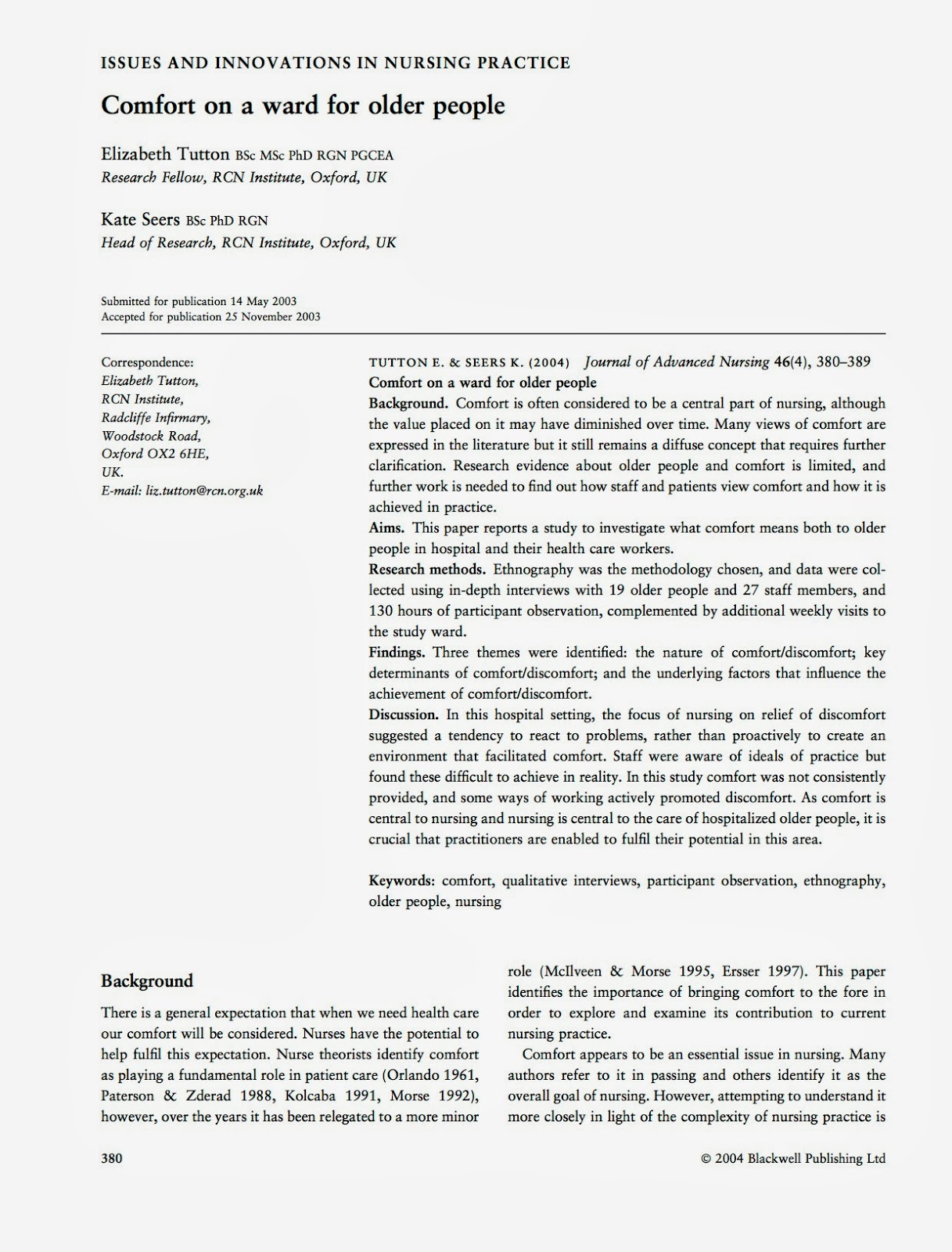
I found a study buy Elizabeth Tutton who looked it to the relationship between elderly people and their nurses in a ward and try to make it more comfortable for them. (Tutton, E., & Seers, K. (2004). Comfort on a ward for older people. Journal of Advanced Nursing, 46(4), 380-389. doi:10.1111/j.1365-2648.2004.03005.x) As a whole didnt relate on what I was trying to find out about physiological comfort but it give some good insight on how nurse perceive comfort and how they create comfort for their patients, The study showed that comfort was an individual process in which every one is different, and staff find out the patients wants and wishes and tries to fulfill them. it was found that the patients felt more comfortable when the nurses had more positive attributes such as; kindness, gentleness, goodness and friendliness. if was found that comfort was also created when the nurse know the patient, their background, likes and dislikes and simple facts about them, this was because knowing the person created a sense of normality and community. The environment provided is also deemed as an important factor in creating comfort, as the patients are in the ward for a long period of time they have to create a space which is welcoming and personal, we the patient can have their own space. comfort is also created in every day activities such as helping to wash someones hair or cutting their nails, also helping assist them in knowing what is happening like providing a mirror so they can see their injuries heal.
this studied show the long term ways to create a comfortable environment and playing on the physiological aspects on comfort, even though I don't have the time to lean the background to the tutors and find out their likes and dislikes and base this experience over the space of a few weeks caring for them and providing their wants and wishes, I could use some of the concepts of what nurses use to create comfort an make a lot shorter experience.
I feel that the main difference between these two types of comfort is time as mental comfort takes a long time to create a comfortable environment I feel would take a few days to create the mentally comfortable environment while physical comfort only lasts a few seconds as when you stop moving/smelling/listening you lose the focus on comfort and will then only consider comfort again when the the action or product is deemed uncomfortable. the factor of time then becomes a big issue of making my experiment as you have to get the time just right to try to create mental and physical comfort.
Physical Comfort:
| Vink, P. (2005). Comfort and design: Principles and good practice. Boca Raton: CRC Press. |
To get a better under standing on physical comfort I read a book by Peter Vink- Comfort and Design.
it book when into great detail on the principles to create a comfortable chair and environment. Vink described comfort as 'freedom from pain; well being', there is at least three problems face us in striving for comfort; 1. the exact cause of discomfort or comfort is unknown, there is no model available that describes the cause of comfort. 2. every individual has his or her own meaning of comfort. comfort is a subjective phenomenon. 3. the comfort design process is not described and the approach is unknown." and 'the product its self can never be comfortable; it becomes comfortable (or not) in its use." This then shows that it is difficult to create an environment or product that is deemed comfortable to ever user. Vink looked into a study by Slater (1985) who "defines comfort as a pleasant state of physiological, psychological and physical harmony between a human being and his or her environment "this shows that for product and physical comfort we also have to factor in the mental aspects of comfort it was also stated "the history of our comfort experiences determines our expectations of a product based on what we are used to" (looze et al. 2003 (comfort and design) which relates back to the physiological aspects of comfort and how it relates back to memory. Vink also described that there was three manifestations when considering making comfort;
"Discomfort- the participant experiences discomfort because of physical disturbances in the environment.
No discomfort- the participant is not aware of discomfort or comfort or there is no discomfort.
Comfort- the participant experiences noticeably more comfort than expected and feels comfortable."
when trying to consider where the user would lie with the different manifestations when using the product Looze et al. (2003) created a model to show the different factors that can action on resulting in the different manifestations;
it described that you not only had to physically feel comfortable but other factors acted on it such as temperature, humidity, noise, state of the person, history and smell, it was reported that even though we are mostly not aware of the effect that smell has on us with comfort it actually influences our experiences.
The book went into detail on the comfort and discomfort specific to seating and how people experienced comfort in their seats, studies where found that the absence of discomfort did not result in comfort. it showed that discomfort was associated with pain and if that was taken away then nothing was experienced, while comfort is retaliated to the sense of well-being and the pleaser the chair gives;
discomfort highlights more physical aspects, such as pain, ache, hurting while comfort shows more of the mental aspects happy, relaxed safe, calm and restful.Vinks Theory on comfort changed my views on Physical Comfort, even though I know it is hard to create a physical object that is deemed comfortable in the sense of touch as comfort is a Subjective experience I can try to create an experience that could create an experience that results in safety, restfulness, happiness and being relaxed with a physical object it will result in the objects making a comfortable experience.
Physiological comfort:
I found that it is very difficult trying to find information on psychological comfort that can be related to design. I found that there is research that has been done with in nurses to help create a comforting environment for their patients, I felt that this could help to relate to the design world. it was described that comfort is the overall role that nurses have to focus on and to achive this they have to first identify patients’ perceptions of their needs (Orlando, 1961). it is also the process to developing a close relationship with the patient which can result in healing and growth (hall, 1964).
I found a study buy Elizabeth Tutton who looked it to the relationship between elderly people and their nurses in a ward and try to make it more comfortable for them. (Tutton, E., & Seers, K. (2004). Comfort on a ward for older people. Journal of Advanced Nursing, 46(4), 380-389. doi:10.1111/j.1365-2648.2004.03005.x) As a whole didnt relate on what I was trying to find out about physiological comfort but it give some good insight on how nurse perceive comfort and how they create comfort for their patients, The study showed that comfort was an individual process in which every one is different, and staff find out the patients wants and wishes and tries to fulfill them. it was found that the patients felt more comfortable when the nurses had more positive attributes such as; kindness, gentleness, goodness and friendliness. if was found that comfort was also created when the nurse know the patient, their background, likes and dislikes and simple facts about them, this was because knowing the person created a sense of normality and community. The environment provided is also deemed as an important factor in creating comfort, as the patients are in the ward for a long period of time they have to create a space which is welcoming and personal, we the patient can have their own space. comfort is also created in every day activities such as helping to wash someones hair or cutting their nails, also helping assist them in knowing what is happening like providing a mirror so they can see their injuries heal.
this studied show the long term ways to create a comfortable environment and playing on the physiological aspects on comfort, even though I don't have the time to lean the background to the tutors and find out their likes and dislikes and base this experience over the space of a few weeks caring for them and providing their wants and wishes, I could use some of the concepts of what nurses use to create comfort an make a lot shorter experience.
Wednesday, 25 September 2013
physical vs mental comfort
I have read quite a lot of readings on comfort and they cover two different concepts of comfort one looks at the physical concept of comfort where they make an object comfortable with the help of space and ergonomics and the other is on the emotional aspect of comfort, making someone feel mentally comfortable in an environment, a lot of nurses use this concept of comfort to make the patients more feel more at home and reassure them that it will be ok. so I when coming to deigning my experience I can go down either paths, to make a physical comfort and make an activity that enhances comfort or I could make the environment more comfortable so when doing the activity you felt reassured and comforted, make the user feel at home, care for them. another reading I had read it said that we take comfort for grated so for us to appreciate comfort we have to have had discomfort
I felt the next step was to thin about different was to create comfort using these different concepts;
- I feel that as we take comfort for grated and we only notice it at the beginning I could make an experience that on focused at the begging of the act for initial comfort. I could look at different materials, like the bootie I had made for the last project that was made of fur and ribbon so that you initially feel comfort but over time you no longer feel comfortable, I found that that bootie was only comfortable with kinetic movement once your foot was inside and you had done up the bootie you no longer noticed the bootie
- another way I could create physical comfort is to make the environment comfortable, such as make a comfortable chair, one that is ergonomically designed to make tying up your shoes easier, such as having it on an angle so that it can be easy to bend down. or have padding around it to create warmth and softness, play soft soothing sounds, pleasant smells.
- I could use the reassurance to create a mental comfortable experience using soft soothing voice and positive words, ask them questions that mother them, and talk to them personally so it wasn't as awkward situation. I feel that the problem with this is that it would be hard to pull off well they could find the situation awkward as they might not understand why you are asking them all those questions and find it more irritating rather then comforting, and as it is such a small task you cant create that closeness and personal interaction.
- in a reading I had found that to create comfort you need discomfort i find that this would be a strong concept as you do feel comfortable on the last experience, but the problem with this projects is that the whole experience as to be comfortable so if I make some components uncomfortable it then defeats the whole experience of being comfortable.
changing the act;
I want to make the act of putting on and tying up your shoes different so you notice the comfort elements. so it decided to think of different was to do this;
- I could pull apart all the different steps of the activity and make each component comfortable in a different way. loosening your lasses, pushing your foot int the shoe and the tension of pulling it on, tightness up the laces, tying the bow. I could take the main ideas of these steps and make them separate and focus on home to make them physically comfortable, such as changing the materials, smell, taste, sight, sound that reflect the steps
- I could enlarge the act and move it away form the foot, such as use the whole body or take it away from the body and have it as an external act, this way you would look at it differently and experience it in a different way, as it is an act you to subconsciously and don't take any notice of it as you do it on a daily basis
comfort and design
Vink, P. (2005). Comfort and design: Principles and good practice. Boca Raton: CRC Press.
I found a book that looked at comfort in the use of products. it focused mostly on ergonomics and space rather then anything else. it described comfort as "influenced by many factors in the environment. that means that it is not easy to design, market or manage with factors of design." "there is at least three problems face us in striving for comfort; 1. the exact cause of discomfort or comfort is unknown, there is no model available that describes the cause of comfort. 2. every individual has his or her own meaning of comfort. comfort is a subjective phenomenon. 3. the comfort design process is not described and the approach is unknown." i found this book more interesting then other reading i had found as it talked more about the physical aspect of comfort rather then the mental aspect. I feel that this would be easier to create an experience.
The problem that keeps on coming up when I read about comfort is that it is a subjective phenomenon this then means that it is up to the user to decide if they are comfortable and everyone will experience it differently. i also fell that comfort can come off as an initial factor and over time you get use to the surrounding and you take comfort for granted so when making my experience I would want it to be short so the user will appreciate it fully.
I found a book that looked at comfort in the use of products. it focused mostly on ergonomics and space rather then anything else. it described comfort as "influenced by many factors in the environment. that means that it is not easy to design, market or manage with factors of design." "there is at least three problems face us in striving for comfort; 1. the exact cause of discomfort or comfort is unknown, there is no model available that describes the cause of comfort. 2. every individual has his or her own meaning of comfort. comfort is a subjective phenomenon. 3. the comfort design process is not described and the approach is unknown." i found this book more interesting then other reading i had found as it talked more about the physical aspect of comfort rather then the mental aspect. I feel that this would be easier to create an experience.
The problem that keeps on coming up when I read about comfort is that it is a subjective phenomenon this then means that it is up to the user to decide if they are comfortable and everyone will experience it differently. i also fell that comfort can come off as an initial factor and over time you get use to the surrounding and you take comfort for granted so when making my experience I would want it to be short so the user will appreciate it fully.
comfort on a ward for old people
I found a reading by Elizabeth Tutton who had written about trying to make elderly patient feel more comfortable with their nursers, I though this reading would give a different approach to how to make an experience more comfortable.
but I found that it didn't relate to the type of comfort I was looking for, it was showing the long term relationship between an elderly patient and there nurse. The study drew on the principles of ethnography (Hammersley & Atkinson 1995), the primary focus of which is to provide a description of a culture by observing, descri- bing and analysing what is happening (Aamodt 1991). This study explored comfort as a specific aspect of a culture and, therefore, is more focussed than traditional ethnographies (Leininger 1985). Gaining trust and having a bond, learning about their lives and hearing their stories. making a more comfortable living environment. Hall (1964, 1969) suggests that comfort is a part of the process of developing closeness with patients which leads to growth and healing. I don't have the time to give my whole life to get to know the tutors and make a comfortable living environment, so I found it was hard to pick out was would be useful to use.
![]() |
| Tutton, E., & Seers, K. (2004). Comfort on a ward for older people. Journal of Advanced Nursing, 46(4), 380-389. doi:10.1111/j.1365-2648.2004.03005.x |
Subscribe to:
Posts (Atom)